
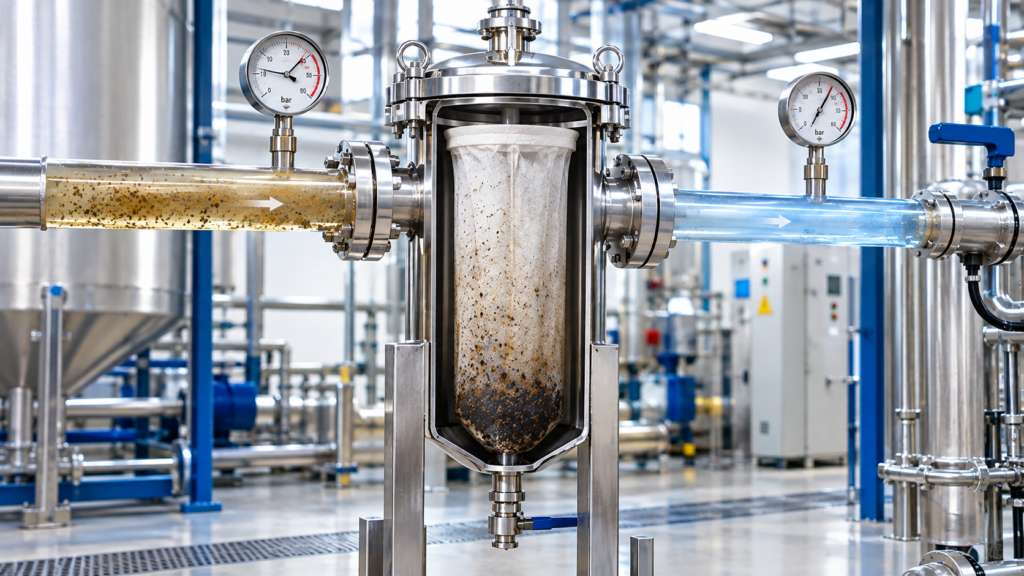
Bag filter pressure drop is the difference between the pressure measured before and after a filter bag. A small increase during operation is normal because the bag gradually collects suspended solids. However, a rapid or unusually high increase can indicate clogging, incorrect filter selection, insufficient filtration area, excessive flow, high fluid viscosity, or a change in process conditions.
Understanding the cause of high differential pressure helps operators maintain flow, extend filter-bag service life, reduce replacement costs, and prevent unplanned downtime. This guide explains the most common causes of liquid bag filter pressure drop and the steps businesses can take to resolve them.
What Is Pressure Drop in a Bag Filter?
Pressure drop, also known as differential pressure (DP), is the pressure difference across a filter.
For example, if the pressure before the filter is significantly higher than the pressure after it, the filter is creating greater resistance to the process flow.
A new or clean filter will normally have a relatively low initial pressure drop. As it captures suspended solids and other contaminants, the filter media becomes progressively loaded. This increases resistance and reduces available flow.
Monitoring differential pressure gives operators an indication of the filtration system’s condition and helps determine when maintenance or filter replacement may be required.
TFI Filtration UK highlights that differential pressure across filtration media generally increases as particles are captured, making correct sizing and filter selection important for maintaining efficient operation.
What Causes Bag Filter Pressure Drop?
Several factors can contribute to excessive pressure drop. Identifying the underlying cause is important because simply replacing the filter may not solve the problem.
1. Filter Bag Loading or Clogging
One of the most common causes is the accumulation of solids on the filter bag.
As the bag captures particles from the process fluid, the available flow area can gradually become restricted. If the contaminant concentration is particularly high, the bag may load much faster than expected.
- Increasing differential pressure
- Reduced flow rate
- More frequent filter changes
- Increasing pump or system load
If the pressure drop rises quickly after installing a new bag, the process may contain more contaminants than originally expected.
2. Incorrect Filter Bag Selection
Filter bags are available in different materials, micron ratings, and configurations. Selecting a bag that is too fine for the application can result in a higher initial pressure drop and faster loading.
The filtration requirement should therefore be considered alongside flow rate, fluid characteristics, operating temperature, contaminant type, and required particle retention.
The correct filter is not necessarily the finest. Choosing the appropriate filtration grade can help balance particle removal, flow, and filter life.
3. Insufficient Filter Area
A filter system needs sufficient surface area to handle the required flow and contaminant load.
If the filtration area is too small for the application, the filter media may become loaded rapidly. This can lead to a rising pressure drop and shorter operating cycles.
Correct system sizing is therefore an important part of industrial filtration design. Proper sizing can also help reduce the overall cost of filtration by improving filter life and reducing unnecessary replacements.
4. High Solids Concentration
Some industrial processes contain significant quantities of suspended solids, fibres, scale, dust or other contaminants.
A higher contaminant load naturally means that the filter will collect material more quickly. If the process conditions change and the solids concentration increases, the pressure drop may also rise faster than usual.
In these situations, it is useful to investigate whether the upstream process has changed rather than assuming the filter itself is the only problem.
5. High Flow Rate
Increasing the process flow rate can increase pressure drop across a filter.
If a system is operating above its original design flow, the filter may experience greater resistance and load more quickly. This can happen after production capacity is increased or when pumps are changed.
Whenever the operating flow changes, filtration capacity should be reviewed.
6. Fluid Viscosity and Temperature
The characteristics of the process fluid can also affect pressure drop.
More viscous fluids generally require greater pressure to move through filtration media. Temperature can influence viscosity and therefore change filtration performance.
For industrial applications involving oils, chemicals, food-processing fluids, or other viscous liquids, filter selection should consider the operating temperature and fluid properties.
How Can You Reduce Bag Filter Pressure Drop?
Reducing excessive pressure drop starts with identifying why it is occurring.
First, check the differential pressure trend rather than looking at a single pressure reading. A gradual increase may simply indicate normal contaminant loading, while a sudden increase can suggest clogging, an incorrect filter, unexpected process contamination, or a change in operating conditions.
- Select the correct filter bag material and micron rating.
- Ensure sufficient filtration area for the required flow.
- Check whether process flow has increased.
- Consider fluid viscosity and operating temperature.
- Review the complete filtration system if pressure drop remains consistently high.
Where appropriate, alternative filtration technologies can also be considered. TFI Filtration UK supplies industrial filtration solutions designed around application requirements, with a focus on filtration performance and total cost of ownership.
How to Diagnose Bag Filter Pressure Drop
The pressure-drop trend can help identify the likely cause of a filtration problem. A gradual increase is often associated with normal contaminant loading, while a sudden or unusually high increase may indicate clogging, incorrect filter selection, excessive flow, or a change in process conditions.
| Pressure-drop behaviour | Likely cause | Recommended action |
| Gradual increase | Normal contaminant loading | Monitor filter performance. |
| Rapid increase | Clogging, high solids, or incorrect filter selection | Check the process and filter rating. |
| High pressure from startup | Insufficient area, high viscosity, or excessive flow | Review system sizing and operating conditions. |
| Increases after production rises | Flow exceeds design capacity | Assess the need for more filtration area. |
| Remains consistently high | Undersized housing, blocked outlet, or process change | Inspect the complete filtration system. |
Why Correct Filtration Design Matters
A bag filter is only one part of an industrial filtration system. Poor filter selection, inadequate capacity, or changing process conditions can affect the performance of the entire installation.
TFI Filtration UK works with industrial customers to provide filtration and separation solutions suited to individual applications. Its filtration expertise covers areas such as filter systems, industrial filter elements, and customised filtration solutions. The company also manufactures products for demanding industrial applications, including wedge-wire slotted filter cartridges designed for high flow, anti-clogging performance, and low pressure drop.
Conclusion
High bag filter pressure drop is commonly caused by clogging, excess solids, incorrect filter selection, insufficient filter area, high flow rates, or changes in fluid viscosity. Identifying the cause early helps maintain flow, extend filter life, and reduce downtime.
If your system is experiencing consistently high pressure drop, contact TFI Filtration UK for help reviewing your filter bag, flow rate, filtration area, and operating conditions. The right filtration solution can improve flow, extend filter life, and reduce unnecessary maintenance costs.