
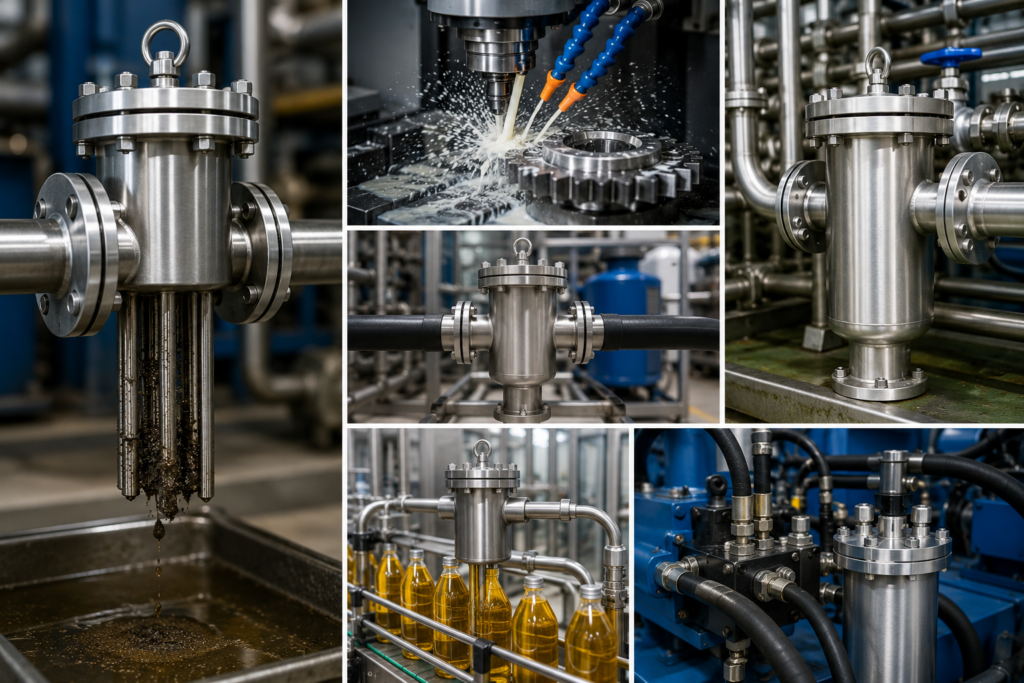
Industrial processes often produce tiny metallic particles through machinery wear, grinding, cutting, pumping and material handling. When these particles enter oils, coolants, chemicals or other process fluids, they can damage equipment, reduce product quality and increase maintenance requirements.
Industrial magnetic filters provide an effective way to capture ferrous and magnetically responsive contaminants before they cause operational problems. They use a strong magnetic field to attract metallic particles from flowing liquids, slurries or selected process materials.
From metalworking and chemical processing to food manufacturing and hydraulic systems, magnetic filtration supports cleaner production, longer equipment life and more reliable operations. This guide explains the most important applications of industrial magnetic filters UK manufacturers and processing plants can consider.
What Are Industrial Magnetic Filters?
Industrial magnetic filters are filtration devices designed to remove iron, steel and other magnetically responsive particles from industrial fluids. The contaminated fluid passes around high-strength magnetic rods, elements or assemblies. Ferrous particles are attracted to the magnetic surface and remain captured until the filter is cleaned.
Unlike conventional barrier filters, magnetic filters do not rely solely on pores to trap contamination. This allows them to capture extremely fine metallic particles that may pass through some traditional filter media.
Depending on the process requirements, magnetic filters can be installed:
- In process pipelines
- Before pumps, valves or heat exchangers
- In coolant circulation systems
- On hydraulic oil return lines
- At storage tank inlets and outlets
Major Applications of Industrial Magnetic Filters
1. Metalworking and Precision Machining
Metalworking is one of the most common applications for magnetic filtration. CNC machining, grinding, milling, honing, lapping and drilling processes continuously generate fine iron and steel particles.
These particles can circulate through coolants and cutting fluids, creating an abrasive effect between tools and workpieces. This may lead to poor surface finishes, reduced component accuracy and accelerated tool wear.
Installing industrial magnetic filters in coolant circulation systems helps remove metallic swarf and fine ferrous particles. Cleaner coolant supports improved machining quality, extended tool life and more consistent production.
Common metalworking uses include:
- CNC machining centres
- Surface and cylindrical grinding
- Steel cutting and drilling
- Gear manufacturing
- Bearing production
- Automotive component machining
2. Chemical Processing
Chemical manufacturing plants frequently process liquids, resins, solvents, coatings and slurries through pumps, mixers, pipelines and storage tanks. Wear within this equipment can introduce metallic contamination into the product.
Magnetic filters can be positioned before sensitive processing equipment or final product transfer points to capture ferrous particles. Stainless steel magnetic filter housings may also be selected for demanding chemical environments, subject to fluid compatibility, temperature and pressure requirements.
Within chemical production, magnetic filters may be used for:
- Liquid chemicals
- Resins and polymers
- Paints and coatings
- Adhesives
- Pigments and dyes
- Industrial cleaning fluids
Removing metal contamination can help protect product quality while reducing damage to pumps, valves and downstream filters.
3. Hydraulic and Lubrication Systems
Hydraulic equipment depends on clean fluid for reliable operation. Pumps, cylinders, bearings, gears and valves naturally produce microscopic wear particles as they operate.
When these particles remain in circulation, they can cause abrasion, blocked control valves, damaged seals and reduced system efficiency. Magnetic filtration installed in return lines, circulation loops or offline filtration units can continuously capture ferrous wear debris.
This application is valuable in manufacturing machinery, presses, test rigs, mobile equipment and heavy engineering systems. Cleaner oil can support longer component life and reduce unplanned maintenance.
4. Automotive Manufacturing
Automotive production uses a wide range of machining, washing, forming and assembly processes. Many of these operations involve metal components and recirculating fluids that can become contaminated with fine steel particles.
Industrial magnetic filters can be applied to engine component machining, transmission manufacturing, bearing production, component washing and grinding systems.
By reducing ferrous contamination, manufacturers can improve component cleanliness, protect precision machinery and minimise the risk of surface damage during production.
5. Food and Beverage Processing
Metal contamination is a serious product-quality concern in food and beverage manufacturing. Small ferrous particles may enter the production line through equipment wear, maintenance work or damaged processing components.
Hygienically designed magnetic filtration systems can be installed in suitable liquid product lines to capture metallic contamination. Applications may include sauces, syrups, oils, chocolate, dairy products and other pumpable food materials.
The magnetic filter must be manufactured from suitable food-contact materials and designed for effective cleaning. It should also form part of a wider contamination-control programme rather than replacing other inspection and filtration methods.
6. Industrial Washing and Cleaning Systems
Parts-washing systems remove oil, dirt and machining residues from manufactured components. During cleaning, metal particles from the parts may enter and circulate through the washing fluid.
Magnetic filters remove these particles before the fluid is sprayed back onto components. This helps maintain cleaner wash fluid, prevents removed debris from being deposited again and may reduce the burden on downstream filters.
They are commonly used in automotive, aerospace, bearing and precision engineering washing systems.
7. Fuel, Oil and Storage Systems
Storage tanks, fuel transfer systems and industrial oil circuits can collect ferrous contamination from corrosion, tank wear, pipelines and handling equipment.
Magnetic filtration can be installed at tank inlets, outlets or recirculation lines to remove magnetically responsive particles from diesel, oils and selected fuels. Material compatibility and safety requirements must always be evaluated before installation.
8. Heating and Cooling Systems
Industrial heating and cooling circuits may develop magnetite and other metallic debris because of internal corrosion. This contamination can restrict flow, reduce heat-transfer efficiency and damage pumps or control valves.
Magnetic filters installed in circulation lines help collect metallic sludge before it settles inside heat exchangers and other critical components. They can be used in industrial heating networks, closed-loop cooling systems and heat-pump installations.
Benefits of Using Magnetic Filters in Industrial Processes
The correct magnetic filter can provide several operational advantages:
- Removal of very fine ferrous contamination
- Better protection for pumps, valves and machinery
- Longer coolant, oil or process-fluid life
- Reduced wear on tools and components
- Fewer disposable filtration consumables
- Improved surface finish and product quality
- Longer service intervals for downstream filters
- Reduced maintenance and production interruptions
Magnetic filtration can also work as a pre-filtration stage. Positioning the magnetic filter before a conventional filter removes ferrous material first, allowing the downstream cartridge or bag filter to focus on non-magnetic contamination.
Choosing the Right Industrial Magnetic Filter
Selecting a magnetic filter requires more than matching the connection size. Consider the fluid type, viscosity, operating temperature, pressure, flow rate and expected contamination load.
Important selection factors include:
Contaminant Type
Confirm whether the contamination is ferrous or magnetically responsive. Magnetic filters will not independently remove every type of solid particle.
Cleaning Method
Manual-cleaning magnetic elements may be suitable for moderate contamination levels. Automated or self-cleaning systems are generally more appropriate for continuous processes and high contamination loads.
Construction Material
The housing, seals and magnetic elements must be compatible with the process fluid and operating environment.
Installation Position
Installing the filter before pumps, sensitive equipment or conventional filtration may provide better overall system protection.
TFI Filtration UK offers magnetic filter elements and magnetic filters for industrial filtration requirements. A properly evaluated system can improve contamination control without unnecessarily restricting process flow.
Conclusion
The applications of Industrial magnetic filters UK plants use extend across metalworking, chemical production, automotive manufacturing, hydraulic systems, food processing, industrial washing and heating systems.
By removing ferrous particles from process fluids, magnetic filters help protect equipment, maintain cleaner products and reduce the operational problems caused by abrasive metallic contamination.
For the strongest filtration performance, magnetic filters may be used alongside conventional filtration technologies. Businesses should evaluate contaminant type, flow conditions, fluid compatibility and cleaning requirements before selecting a system.
Contact TFI Filtration UK to discuss an industrial magnetic filtration solution suitable for your process.