
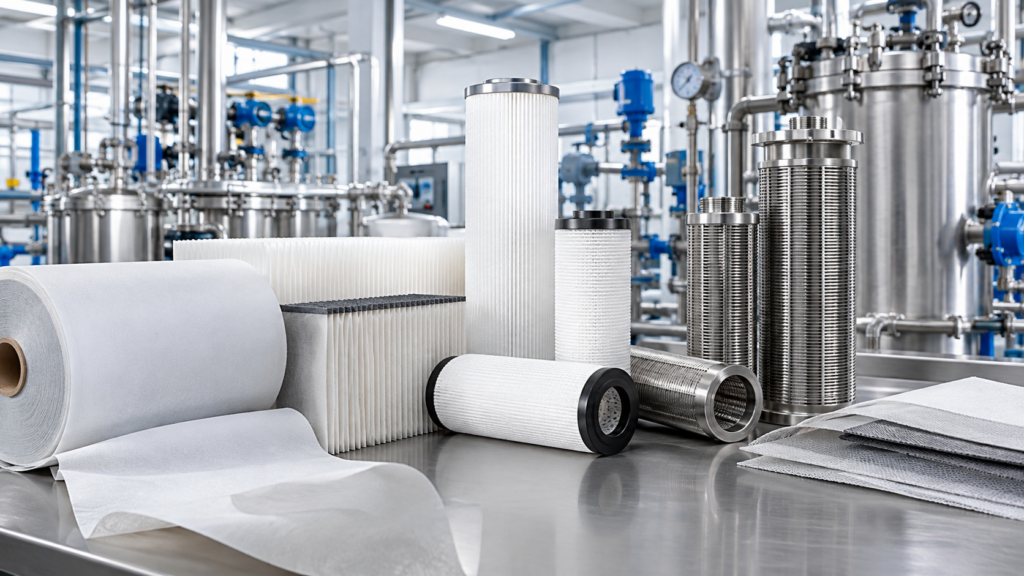
Choosing the right filter media is not simply about selecting a micron rating. In an industrial filtration system, the media must work with the process fluid or gas, operating pressure, temperature, contaminant load, flow rate, and cleaning method.
The right choice can help maintain stable flow, protect downstream equipment, improve filtration efficiency, and extend filter service life. The wrong media can result in excessive pressure drop, frequent filter replacement, poor filtration performance, and unnecessary downtime.
For UK manufacturers and process industries, selecting the right filtration media is therefore an important part of controlling both performance and operating costs.
What Is Filter Media?
Filter media is the material within a filtration element that separates unwanted particles or contaminants from a liquid, gas, or air stream.
The media can be designed for different filtration mechanisms and operating conditions. Depending on the application, filtration may involve surface filtration, depth filtration, or mechanical separation through a precisely designed opening.
However, the media should not be considered in isolation. The filter element, housing, flow conditions, contaminant characteristics and cleaning method all influence the final performance of the filtration system.
What Should You Consider When Selecting Filter Media?
The most suitable filter media depends on the actual conditions in which the filter will operate.
1. What Are You Filtering?
Before selecting filter media, identify exactly what the filtration system needs to remove and the conditions under which it will operate. The nature of the process fluid or gas has a direct impact on media selection, filter construction, filtration rating, and expected service life.
Industrial filtration applications can involve:
- Process and cooling water
- Chemicals and aggressive process fluids
- Oils and hydrocarbon-based liquids
- Wastewater and suspended solids
- Compressed air and industrial gases
- Food and beverage process streams
- Abrasive fluids and high-particle-load applications
Look beyond the name of the fluid. Consider particle size, contaminant concentration, viscosity, temperature, chemical compatibility, and flow characteristics. Sticky, fibrous or abrasive contaminants can behave very differently from fine, hard particles and may require a different filtration approach.
Understanding these conditions at the start helps prevent problems such as rapid media loading, excessive pressure drop, and frequent filter replacement. It also allows the filter media, filter element, and overall filtration system to be selected around the actual process rather than a standard specification.
2. What Size Must Be Removed?
Particle size is one of the most important considerations when specifying industrial filtration.
A micron rating indicates the approximate particle size a filter is designed to retain, but micron rating alone does not determine overall filtration performance.
Particle shape, concentration, loading, and whether the contaminant is hard, soft, sticky, or fibrous can also affect filter life and pressure drop.
For liquid filtration, TFI explains that the micron rating determines the size of particles retained and that particles may be captured on the inside or outside of an element depending on its design.
3. What Flow Rate Do You Need?
A filter must handle the required process flow without creating unnecessary restriction.
If the filtration area is too small, particles can load the media quickly, and pressure drop can increase. A correctly sized filter provides sufficient filtration area for the required flow while maintaining practical operating conditions.
This is why industrial filter selection should consider flow rate, filter area, contaminant loading and pressure drop together, rather than focusing on a single specification.
4. What Are the Pressure and Temperature Conditions?
Industrial processes can operate under demanding pressure and temperature conditions.
The selected media and filter construction need to withstand the application’s operating environment without deformation, damage or loss of filtration performance.
For applications involving pressure fluctuations, vibration or demanding process conditions, the mechanical construction of the filter element becomes particularly important.
TFI’s wedge-wire filter cartridges, for example, are designed with features including self-supporting construction, resistance to vibration and abrasion, high flow capacity and low pressure drop.
What Factors Affect Filter Media Performance?
Selecting the right filter media is only one part of achieving reliable industrial filtration. The design of the filter element also affects flow, particle retention, pressure drop, and overall service performance.
For demanding industrial applications, the filter needs to provide sufficient filtration area while maintaining the required process flow. The supporting structure must also withstand the operating pressure, temperature, vibration and contaminant conditions.
Factors such as element construction, filtration area, flow direction, particle loading and cleaning requirements should therefore be considered alongside the media itself.
TFI Filtration UK provides application-focused filtration solutions designed around specific process requirements. Its range includes specialist filter elements and industrial filtration systems developed for applications where filtration performance, durability and operating efficiency are important.
When specifying filter media, considering the complete filter design rather than the media alone can help achieve more consistent filtration and longer operating performance.
How Does Pressure Drop Affect Filter Media Selection?
Pressure drop is the difference in pressure between the upstream and downstream sides of a filter.
As contaminants accumulate, the resistance to flow can increase. Excessive pressure drop may restrict process flow and increase the energy required to operate the system.
For this reason, pressure drop should be considered during filter selection, not only after a system has been installed.
A suitable filtration design should provide the required level of particle removal while maintaining an acceptable flow rate and pressure drop.
TFI specifically highlights low pressure drop as an important performance characteristic in its filtration solutions.
Filter Media vs Filter Element: What Is the Difference?
Although these terms are sometimes used together, they are not the same.
Filter media is the material responsible for separating or retaining contaminants.
A filter element is the complete filtration component incorporating the media and its supporting construction.
| Filter Media | Filter Element |
| Performs the filtration | Contains or supports the filtration media |
| Determines how particles are captured | Provides the complete functional filter component |
| Can have different materials and constructions | Can be supplied in different shapes and designs |
| Selected according to process requirements | Selected according to the filtration system |
Understanding this difference helps when discussing filtration requirements with a filter media manufacturer or industrial filtration supplier.
Why Application-Specific Filter Media Matters
There is no single filter media solution suitable for every industrial process.
Two companies may require the same nominal micron rating but need completely different filter constructions because their flow rates, contaminant loading, temperature, pressure, or cleaning requirements are different.
TFI Filtration UK takes an application-focused approach to filtration, with its engineering capability covering filtration, separation, purification and cleanliness-related requirements.
Its filtration solutions include cartridge filter systems, filter elements and specialist industrial filtration products designed around different operating requirements.
This makes application assessment an important step before specifying the final filtration solution.
How TFI Filtration UK Can Help
Selecting industrial filter media can be challenging when the process involves high flow rates, demanding temperatures, pressure fluctuations, abrasive contaminants or strict filtration requirements.
TFI Filtration UK Ltd. provides industrial filtration solutions designed around individual application requirements. Its product and engineering capabilities cover filter media, filter elements and complete filtration systems for industrial processes.
The company also offers specialist solutions such as wedge-wire slotted filter cartridges, which are designed for high flow, low pressure drop and demanding industrial environments.
Rather than selecting a filter based solely on micron rating, businesses can assess the complete operating conditions and choose a filtration solution that balances performance, service life, maintenance and total cost.
FAQ
What is filter media used for?
Filter media is used to separate unwanted particles and contaminants from liquids, gases or air. It forms the functional filtration surface within a filter element.
How do I choose the right filter media?
Consider the process fluid or gas, contaminant type, particle size, flow rate, pressure, temperature, chemical compatibility, and cleaning requirements. The filter element and housing should also be considered as part of the complete system.
Does a higher micron rating mean better filtration?
Not necessarily. A lower micron rating may provide finer particle retention, but filtration performance must also be considered alongside flow rate, pressure drop, contaminant loading, and the requirements of the process.
What causes pressure drop across a filter?
Pressure drop can increase as contaminants accumulate on or within the filter media. Incorrect sizing, excessive contaminant loading, or unsuitable filter design can also contribute to excessive flow restriction.
Choose the Right Filter Media for Your Process
The right filter media should do more than remove particles. It should work reliably within the complete filtration system while supporting the required flow, pressure, service life, and maintenance strategy.
For UK industrial applications, an application-specific approach can help avoid unnecessary filter replacement, excessive pressure drop, and avoidable downtime.
Need help selecting filter media or an industrial filtration system? Contact TFI Filtration UK Ltd. to discuss your application, operating conditions, and filtration requirements.