
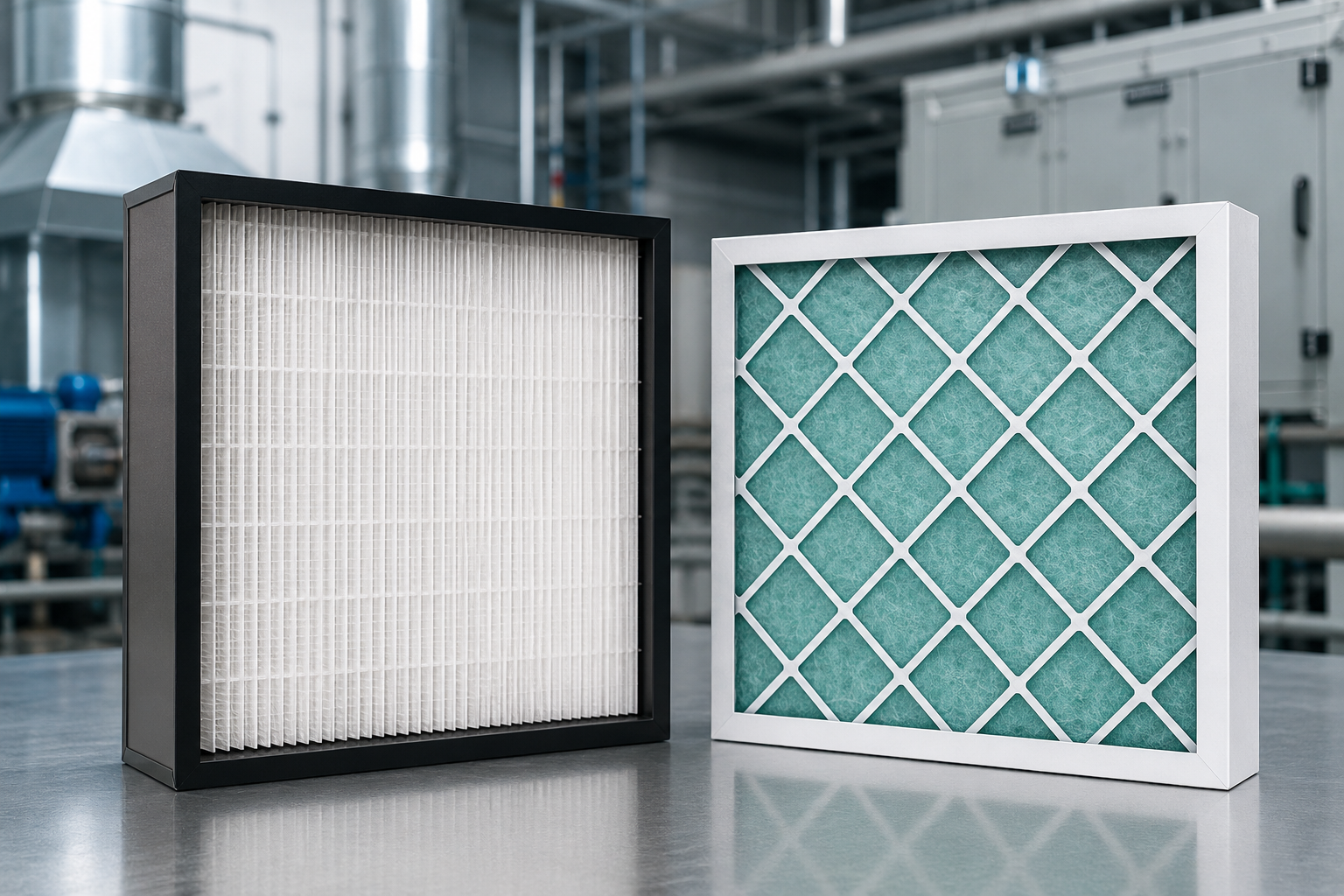
A filtration system is important for maintaining clean air, protecting equipment, and supporting efficient industrial operations. However, with different filtration technologies available, selecting the most suitable option can be challenging.
HEPA filters and Panel filters are two commonly used solutions for industrial air filtration. While both are designed to remove airborne particles, they serve different purposes and offer different levels of filtration efficiency.
So, should your facility use HEPA filters, panel filters, or a combination of both? The answer depends on your air quality requirements, application, airflow, operating conditions, and required filtration efficiency.
In this guide, we explain the key differences between HEPA and panel filters to help you make a more informed choice.
What Are HEPA Filters?
HEPA stands for High-Efficiency Particulate Air. These filters are designed to capture extremely fine airborne particles and are used in environments where maintaining very clean, controlled air quality is critical.
They are widely used across industries such as pharmaceuticals, healthcare, laboratories, electronics manufacturing, and food processing, where even microscopic contaminants can affect product quality, safety, or compliance standards.
HEPA filters are constructed using tightly pleated filter media, which significantly increases the surface area available for particle capture and improves overall filtration efficiency. However, this dense structure also creates higher airflow resistance, which gradually increases as the filter loads with dust and contaminants over time.
For this reason, it is essential to carefully consider system airflow requirements, compatibility with existing equipment, and ongoing maintenance schedules when selecting and installing a HEPA filtration solution.
What Are Panel Filters?
Panel filters are generally used as a practical and economical solution for removing dust, dirt, fibres, and other larger airborne particles from ventilation and industrial air-handling systems. They are commonly installed in HVAC systems, air intake systems, ventilation equipment, manufacturing facilities, and as pre-filtration stages before higher-efficiency filters.
One of the major advantages of panel filters is their simple construction and ease of replacement. They can help protect downstream equipment and improve the overall performance of a multi-stage filtration system.
TFI Filtration UK offers Panel Air Filters & Systems designed for industrial and commercial filtration requirements.
HEPA Filters vs Panel Filters: The Key Difference
The main difference is filtration efficiency and application.
HEPA filters are selected when extremely high particle removal is required, while panel filters are often used for general air filtration and pre-filtration.
A panel filter may be sufficient for removing larger dust particles from incoming air. However, if the process requires the removal of very fine airborne particles, a HEPA filter may be more appropriate.
This does not necessarily mean that HEPA filters are always the better choice. Using a high-efficiency filter where it is not required can increase system resistance and operating costs. The filter should match the actual requirements of the application.
When Should You Choose Panel Filters?
Panel filters can be a good choice when your primary objective is general air cleaning and equipment protection.
- The incoming air contains dust and larger particles.
- A cost-effective filtration stage is required.
- Frequent filter replacement needs to be simple.
- The system requires pre-filtration before a finer filter.
- Extremely high particle removal is not necessary.
Panel filters are also commonly used as the first stage in a multi-stage filtration system. By removing larger particles before they reach a HEPA filter, they can help extend the service life of the more expensive final-stage filter.
When Are HEPA Filters the Better Choice?
HEPA filters become more suitable when controlling fine airborne particles is a critical part of the process.
- Pharmaceutical manufacturing
- Laboratories
- Healthcare applications
- Electronics and precision manufacturing
- Food and beverage processing
- Applications requiring high-efficiency particle removal
The exact filter specification should always be selected according to airflow, particle characteristics, temperature, humidity, system design, and required performance.
The EPA also notes that pressure drop and filter loading should be considered when designing systems using HEPA filtration.
Can You Use Panel and HEPA Filters Together?
Yes. In many industrial filtration systems, using both can be more effective than choosing only one.
A typical arrangement may use a panel filter as a pre-filter, followed by a higher-efficiency filter such as HEPA.
The panel filter captures larger contaminants first, reducing the particle load reaching the HEPA filter. The HEPA filter then provides the final high-efficiency filtration stage.
This staged approach can improve overall filtration performance while helping manage maintenance requirements and filter replacement costs.
However, the system should be properly designed so that airflow, pressure drop, filter loading, and equipment capacity remain within acceptable limits.
How to Choose the Right Industrial Filter
Before selecting between HEPA filters and panel filters, consider more than just filtration efficiency. Start by identifying the type and size of particles present in your air stream. Next, determine the required airflow and available space for the filter. Operating temperature, humidity, contamination levels, pressure drop, maintenance requirements, and replacement costs should also be evaluated.
Most importantly, consider the purpose of filtration. If you simply need to remove larger dust particles and protect equipment, a panel filter may be sufficient. If your process demands very high removal efficiency for fine airborne particles, HEPA filtration may be necessary.
For complex industrial applications, working with experienced industrial filtration specialists can help you select a solution based on actual operating conditions rather than choosing a filter solely by its efficiency rating.
Final Thoughts
There is no universal answer as to whether HEPA filters or panel filters are better. The right choice depends on your application, required air cleanliness, particle size, airflow, maintenance needs, and operating budget.
Panel filters are often an excellent choice for general filtration and pre-filtration, while HEPA filters provide significantly higher particle removal efficiency for demanding applications. In many systems, combining both technologies can deliver an effective balance between protection, performance, and operating cost.
For specialised requirements, TFI Filtration UK Ltd provides a range of industrial filtration systems and filter products, including HEPA filters, panel air filters, cartridge filters, dust collector filters, and other filtration solutions.
Faqs
1. What is the difference between HEPA filters and panel filters?
HEPA filters are designed to provide very high-efficiency filtration of fine airborne particles, while panel filters are generally used for removing larger dust, dirt, fibres, and other contaminants. Panel filters are also commonly used as pre-filters before HEPA filters.
2. Are HEPA filters better than panel filters?
Neither is universally better. HEPA filters are suitable when very high particle removal is required, while panel filters are more appropriate for general air filtration and equipment protection. The right choice depends on the application’s filtration requirements.
3. Where are HEPA filters commonly used?
HEPA filters are commonly used in pharmaceutical manufacturing, laboratories, healthcare facilities, electronics manufacturing, food processing, and other environments where controlling fine airborne particles is important.
4. What are panel filters used for?
Panel filters are commonly used to remove dust, dirt, fibres, and larger airborne particles from ventilation and air-handling systems. They can also protect downstream equipment and act as a pre-filtration stage.
5. Can panel filters and HEPA filters be used together?
Yes. Panel filters can be installed as a pre-filter before HEPA filters. The panel filter captures larger particles first, helping reduce the particle load on the HEPA filter and potentially extending its service life.
6. How do I choose the right industrial filter?
Consider particle size, required filtration efficiency, airflow, operating temperature, humidity, pressure drop, available installation space, maintenance requirements, and operating costs. These factors can help determine whether panel filters, HEPA filters, or a combination is appropriate.
7. What factors affect industrial filter performance?
Filter performance can be affected by airflow rate, particle concentration and size, filter media, pressure drop, operating temperature and humidity, installation quality, and the condition of the filter during operation.
8. Does TFI Filtration UK supply HEPA and panel filters?
Yes. TFI Filtration UK Ltd provides industrial filtration solutions, including HEPA filters and panel air filtration systems, for different industrial and commercial applications.