
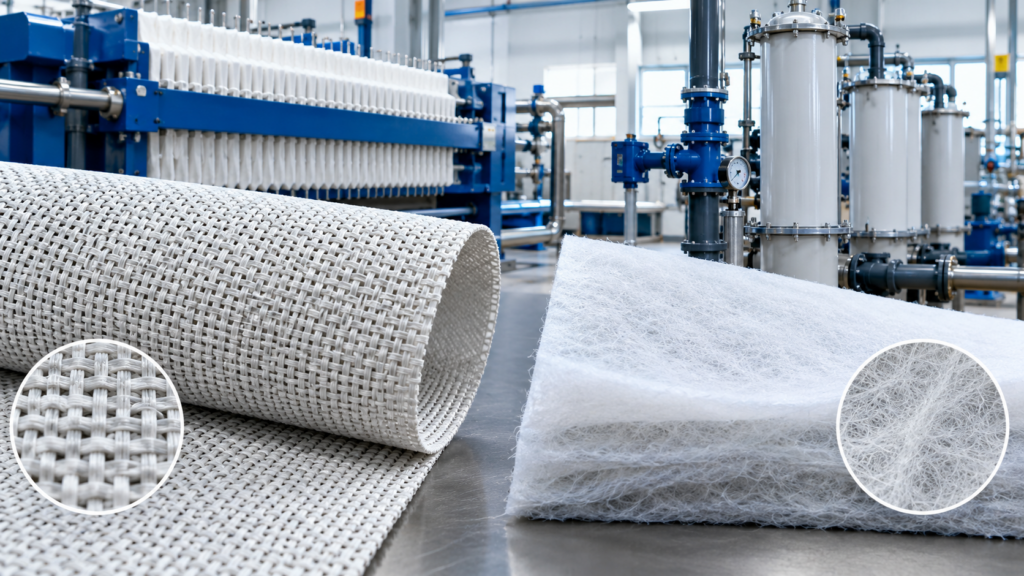
Industrial filtration plays a vital role in maintaining product quality, protecting equipment, and improving process efficiency. Choosing the correct filter material can significantly affect filtration performance, maintenance costs, and operational reliability. Two of the most commonly used options are woven vs non-woven filter media.
Both types of filter media are designed to remove unwanted particles from liquids, air, and gases, but their structure and performance characteristics are different. Understanding these differences helps industries select the right filtration solution for their specific requirements. TFI Filtration UK provides a wide range of filter media designed for applications including air filtration, liquid filtration, dust collection, and industrial separation processes.
What Is Woven Filter Media?
Woven filter media is manufactured by interlacing yarns or fibres in a structured pattern. The controlled weaving process creates a strong and stable filter fabric with uniform openings. This makes woven media suitable for applications where accurate particle separation, durability, and easy cleaning are important.
Woven filter fabrics are commonly made from materials such as polypropylene, polyester, nylon, and acrylic fibres. They are widely used in filter presses, vacuum drum filters, rotary drum filters, and other industrial filtration systems where effective solid-liquid separation is required.
Advantages of Woven Filter Media
Woven filter media offers several benefits:
- High mechanical strength: The woven structure provides excellent resistance to stretching and tearing.
- Consistent filtration performance: Uniforms openings allow predictable particle removal.
- Better cake release: Filter cakes can often be removed easily, improving cleaning efficiency.
These qualities make woven filter media a preferred choice for demanding industrial applications where long service life is required.
What Is Non-Woven Filter Media?
Non-woven filter media is made by bonding fibres together without weaving them into a traditional fabric structure. Fibres are arranged randomly and bonded using methods such as needle punching, thermal bonding, or chemical bonding.
The three-dimensional fibre arrangement creates a depth filtration structure, allowing particles to be captured throughout the thickness of the media. Non-woven filter fabrics are commonly used for air filtration, dust collection, coolant filtration, and pre-filtration applications.
Advantages of Non-Woven Filter Media
Key benefits of non-woven filter media include:
- High dirt-holding capacity: The deeper fibre structure captures more contaminants.
- Excellent filtration efficiency: Suitable for removing fine particles.
- Flexible material options: Available in polypropylene, polyester, glass fibre, cotton, and other materials.
- Lightweight construction: Ideal for disposable and pre-filter applications.
TFI Filtration UK supplies non-woven filter media for industrial uses such as metalworking coolant filtration, grinding, machining, and other processes requiring effective particle removal.
Woven vs Non-Woven Filter Media: Key Differences
When comparing woven vs non-woven filter media, the main differences are related to structure, filtration method, durability, and application.
| Feature | Woven Filter Media | Non-Woven Filter Media |
| Structure | Interwoven yarn pattern | Bonded fibre structure |
| Filtration Type | Mainly surface filtration | Mainly depth filtration |
| Strength | Higher mechanical strength | Good flexibility |
| Particle Holding | Lower depth holding capacity | Higher dirt retention |
| Common Uses | Filter presses, drum filters, separation systems | Air filters, coolant filters, dust collection |
Which Filter Media Is Better for Industrial Filtration?
There is no single answer to which filter media is better. The right choice depends on the application, operating conditions, particle size, and filtration requirements.
Woven filter media is usually better when industries require durability, repeated cleaning, and reliable performance under mechanical stress. It is commonly selected for heavy-duty filtration processes involving liquid-solid separation.
Non-woven filter media is often the better option when high particle capture efficiency and greater dirt-holding capacity are required. It works well for applications involving fine contaminants, air filtration, and pre-filtration systems.
For example, industries using filter presses or rotary drum filters may benefit from woven fabrics, while industries requiring coolant filtration or air pre-filters may find non-woven materials more suitable. TFI Filtration offers customized filter media solutions based on specific industrial requirements.
Factors to Consider When Selecting Filter Media
Before choosing between woven and non-woven filter media, industries should consider:
- Type of contaminant: Larger particles and solid-liquid separation may require woven media, while finer particles may need non-woven media.
- Operating temperature: Filter material should match the process environment.
- Chemical compatibility: The media must resist chemicals present in the application.
- Cleaning requirements: Reusable applications often favour woven filter fabrics.
- Filtration accuracy: The required micron rating plays an important role in selection.
Choosing the wrong filter media can lead to pressure drop issues, frequent replacements, and reduced filtration efficiency.
Applications of Woven and Non-Woven Filter Media
Both woven and non-woven filter media are used across many industries, including:
- Chemical processing
- Food and beverage manufacturing
- Pharmaceutical production
- Metalworking and machining
- Dust collection systems
- Water and wastewater treatment
- Compressed air filtration
Industrial filtration systems often combine different filtration stages to achieve the required level of cleanliness and process efficiency.
FAQs
1. What is the main difference between woven and non-woven filter media?
The main difference is their structure. Woven filter media uses interlaced yarns, while non-woven filter media uses bonded fibres arranged in a three-dimensional structure.
2. Is non-woven filter media better for fine particle filtration?
Non-woven filter media is often preferred for fine particle filtration because its depth structure can capture contaminants throughout the media.
3. Which filter media is suitable for liquid filtration?
Both can be used for liquid filtration. The choice depends on the application, particle size, pressure conditions, and filtration requirements.
4. How do I choose the right industrial filter media?
Consider factors such as filtration rating, material compatibility, operating conditions, cleaning requirements, and the type of contaminants being removed.
Conclusion
Understanding woven vs non-woven filter media is essential for selecting an efficient industrial filtration solution. Woven filter media provides strength, durability, and excellent performance in demanding separation applications, while non-woven filter media offers high dirt retention and effective fine particle filtration.
The best choice depends on your specific industrial process, filtration goals, and operating environment. Working with an experienced filtration provider can help ensure better performance, reduced maintenance, and improved efficiency.
TFI Filtration UK provides customised industrial filter media solutions designed to meet different filtration challenges. Explore our range of filter media and industrial filtration products to find the right solution for your application.