
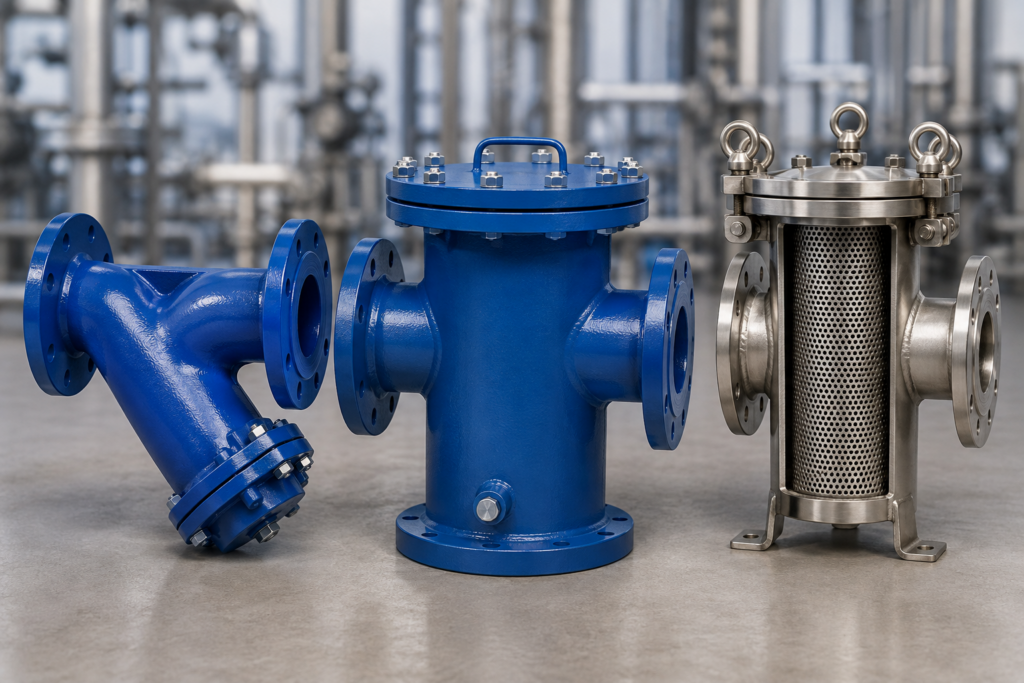
Industrial filtration plays a critical role in protecting pumps, valves, heat exchangers, flow meters, and other pipeline equipment from solid contaminants. Even small particles such as rust, welding slag, scale, or debris can reduce efficiency, increase maintenance costs, and lead to costly equipment failures. Installing the right industrial strainer helps maintain a clean process flow while improving the reliability of the entire system.
When selecting a pipeline strainer, engineers and plant managers often compare a T-Type Strainer vs Y Type Strainer. Both are designed to remove unwanted particles from liquids, steam, or gases, but they differ in design, filtration capacity, maintenance requirements, and ideal applications. In many high-capacity systems, a Basket Type Strainer is also considered because of its larger dirt-holding capability.
This guide explains the key differences between these strainers, their advantages, and how to choose the right option for your industrial process.
Understanding Industrial Strainers
Industrial strainers are mechanical filtration devices installed in pipelines to remove larger solid particles before they reach sensitive equipment. Unlike fine filters that capture microscopic contaminants, strainers are designed to protect downstream equipment from debris that can cause blockages, wear, or damage.
Choosing the correct strainer depends on factors such as fluid type, contamination level, operating pressure, flow rate, available installation space, and maintenance frequency.
What Is a Y-Type Strainer?
A Y-type strainer is named after its Y-shaped body. It contains a perforated or mesh screen positioned at an angle inside the housing. As fluid passes through the strainer, solid particles remain trapped in the screen while clean fluid continues through the pipeline.
Because of its compact construction, the Y Type Strainer is widely used in installations where space is limited. It performs well in high-pressure and high-temperature systems and can be installed in both horizontal and vertical pipelines, depending on the application.
Its compact size, ease of maintenance, and cost-effectiveness make it one of the most commonly used industrial strainers across water treatment, steam systems, HVAC, chemical processing, and utility pipelines.
What Is a T-Type Strainer?
A T-Type Strainer features a T-shaped body with a larger internal filtration chamber. The larger chamber provides greater dirt-holding capacity, allowing the strainer to operate longer before cleaning is required.
Compared with a Y Type Strainer, the T Type design creates lower pressure loss and performs better in applications involving higher flow rates or fluids containing larger amounts of suspended solids.
These strainers are commonly used in continuous industrial processes where minimizing maintenance downtime is essential. Industries such as oil & gas, petrochemical processing, power generation, chemical manufacturing, and heavy industrial plants frequently use T Type strainers because of their durability and efficiency.
T Type Strainer vs Y Type Strainer
Although both strainers perform the same primary function, their designs make them suitable for different operating conditions.
| Feature | Y Type Strainer | T Type Strainer |
| Body Design | Compact Y-shape | Larger T-shape |
| Dirt Holding Capacity | Moderate | High |
| Installation Space | Requires less space | Requires more space |
| Pressure Drop | Slightly higher | Lower |
| Flow Capacity | Moderate | High |
| Maintenance | More frequent cleaning | Longer cleaning intervals |
| Best For | Clean fluids, steam, water | High-flow industrial systems |
Y Type Strainer is generally preferred for compact systems with relatively clean fluids, while a T Type Strainer is better suited for large pipelines handling higher contamination levels.
Where Does a Basket Type Strainer Fit?
A Basket Type Strainer is another widely used industrial filtration solution. Instead of an angled screen, it uses a removable cylindrical basket that offers a much larger filtration area and significantly higher dirt-holding capacity.
Because of its design, a Basket Type Strainer is ideal for applications where fluids contain larger quantities of suspended solids. It also reduces cleaning frequency, making it suitable for continuous production environments.
Basket Type Strainers are commonly installed in:
- Water treatment plants
- Food and beverage processing
- Pharmaceutical manufacturing
- Chemical processing
- Marine systems
- Pulp and paper industries
For systems requiring maximum debris retention and minimal downtime, Basket Type Strainers are often the preferred choice.
How to Choose the Right Strainer
Selecting the right industrial strainer involves more than comparing designs. The operating conditions of your process should always guide the decision.
If your system operates with clean water, steam, or gas and installation space is limited, a Y Type Strainer provides reliable protection with a compact footprint.
If the process involves higher flow rates or larger amounts of contamination, a T Type Strainer offers greater dirt-holding capacity and requires less frequent maintenance.
Where heavy debris loads are expected, and maintenance shutdowns must be minimised, a Basket Type Strainer provides the largest filtration area and longest operating cycle.
Considering flow rate, pressure, temperature, fluid characteristics, particle size, and maintenance schedules will help ensure the best long-term performance.
Industrial Applications
| Industry | Strainer Type |
| Water Treatment | Y Type / Basket Type |
| Steam Systems | Y Type |
| HVAC | Y Type |
| Chemical Processing | T Type / Basket Type |
| Oil & Gas | T Type |
| Petrochemical Plants | T Type |
| Food Processing | Basket Type |
| Pharmaceutical Industry | Basket Type |
| High Flow Industrial Pipelines | T Type |
Why Choose TFI Filtration UK?
At TFI Filtration UK, we manufacture high-quality industrial filtration solutions designed for reliable performance across demanding industries. Our range of Y Type Strainers, T Type Strainers, and Basket Type Strainers is engineered to provide efficient contaminant removal, reduced maintenance, and long service life.
Whether your application involves water treatment, chemicals, pharmaceuticals, food processing, oil & gas, or power generation, our filtration products are designed to protect critical equipment and improve process efficiency.
Conclusion
When comparing T Type Strainer vs Y Type Strainer, there is no one-size-fits-all solution. The right choice depends on your pipeline size, flow rate, contamination level, available space, and maintenance requirements.
Y Type Strainer is an excellent option for compact, high-pressure systems with relatively clean fluids. T Type Strainer offers better performance for high-flow applications and processes with greater contamination. Where maximum dirt-holding capacity is required, a Basket Type Strainer provides an effective and dependable solution.
Choosing the correct industrial strainer not only protects valuable equipment but also improves operational efficiency, reduces downtime, and lowers overall maintenance costs.
Faq
1. What is the difference between a T Type Strainer and a Y Type Strainer?
A Y Type Strainer has a compact Y-shaped design suitable for clean fluids and limited spaces, while a T Type Strainer has a larger filtration chamber designed for higher flow rates and greater dirt-holding capacity.
2. When should I use a Basket Type Strainer?
A Basket Type Strainer is ideal for applications with higher levels of suspended solids where longer operating cycles and reduced maintenance are required.
3. Which strainer is better for high-pressure systems?
Y Type Strainers are commonly used in high-pressure and high-temperature applications because of their compact and robust design.
4. Which industries commonly use T Type Strainers?
T Type Strainers are widely used in oil & gas, chemical processing, petrochemical plants, power generation, and other heavy industrial applications.